Skip to content


Most buyers who walk away from an EV aren't saying no. They're saying "I'm not sure yet". They don't know what a good battery looks like, how far the car will really go, how long it takes to charge or what it will cost to run. If your website can't teach them, they won't ring to ask. They'll go back to search.
The question behind the hesitation
Nobody needed a lesson to buy a petrol hatchback. An EV is different, and the doubt is real: 57% of drivers say they would only consider a used EV that comes with a battery health certificate. That isn't a buyer who has decided against EVs. It's a buyer waiting to be convinced.
So the job of an EV vehicle page isn't only to sell the car. It's to educate first, then sell. Answer the questions in the order the buyer asks them, on the page where they're asking, and the reservation becomes the easy part.
Here's how retailers on Autonomy are doing exactly that today.
"Is the battery OK?"
Hippo Motor Group tests the batteries on its used EVs through a third-party test, and since June 2026 the result has appeared on its vehicle pages.
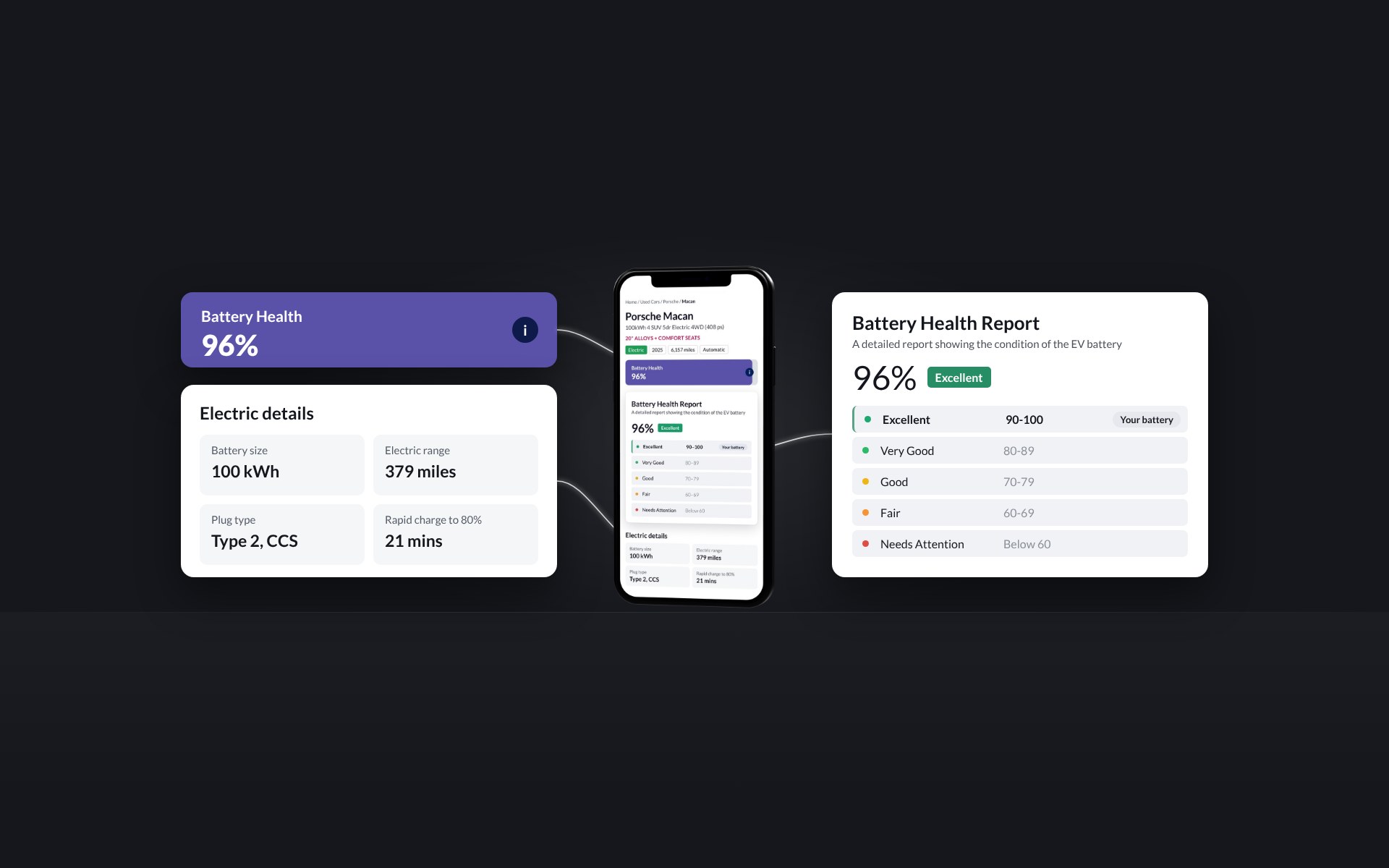
On a 2025 Porsche Macan Electric, a Battery Health bar sits near the top of the page, alongside the price and key facts: 96%. It's up there deliberately, so a buyer on a phone sees it without scrolling. Tap the info icon and a Battery Health Report explains where that battery sits on a scale:
- Excellent: 90 to 100
- Very Good: 80 to 89
- Good: 70 to 79
- Fair: 60 to 69
- Needs Attention: below 60
This one is marked "Your battery", in the Excellent band. In two taps, a buyer who didn't know what a good battery looked like now does.
Educate first, then sell. Answer the battery question before the buyer has to ask it.
"How far will it go, and how long does it take to charge?"
Every EV on an Autonomy site can carry an Electric details panel. On a used BYD Dolphin Surf at All Electric, it reads: 43 kWh battery, 193 miles of range, Type 2 and CCS plugs, five hours to fully charge and 30 minutes on a rapid charger to 80%.
Six plain facts, no jargon. The buyer can picture their own week with the car: the commute, the weekend away, the stop on the motorway.
"What will it cost me to run?"
Directly underneath sits a fuel cost calculator, headed "Costs of driving electric". The buyer picks petrol or diesel, enters their current MPG and annual mileage, chooses anything from one to ten years of ownership, and sees their fuel bill side by side with the cost of charging this car off peak.
It turns "EVs are cheaper to run" from a claim into their own number.
"Is an EV right for me?"
Some buyers aren't ready for a vehicle page yet. They're still working out what an EV, a hybrid or a plug-in hybrid even is. Autonomy sites give retailers room to teach that too.
All Electric runs an Electric & Hybrid section in its main menu, electric and hybrid filters across new and used stock, and a BYD Technology guide that explains plug-in hybrids, the Blade Battery and what a "New Energy Vehicle" actually is. Kearys Leasing has an Electric Vehicle Leasing guide covering running costs, SEAI grants and reduced Benefit in Kind for company car drivers.
For lease and business vehicles, Autonomy can now also show a Benefit in Kind calculator, so a business customer sees their likely monthly company car tax alongside the lease price.
Behind the page
None of this asks a retailer's team to type figures in by hand.
Every vehicle record in Autonomy holds the EV essentials: range, battery capacity, charge times and charger types. When a car is added by registration lookup, the charge time information is saved automatically.
Battery health works the same way. Hippo's test results are pulled into Autonomy once a day and matched to each car by its VIN, so the result sits on the vehicle record like its mileage or colour. If a car hasn't been tested, the block simply doesn't appear. We built it into Autonomy's import tools, so any retailer that tests its batteries can bring those results in.
Our newest release goes further. Each electric or plug-in hybrid vehicle is now matched automatically to its record in EV Database, which supplies official and real-world range by driving condition and weather, efficiency, home charging times and rapid charging figures. Staff can review each match in the admin, pick a different record or mark a car as having no EV data, and a filter on the stock list shows which cars need a look.
Teach first. The sale follows.
Plenty of retailers already know the answers to every one of these questions. Far fewer put them where the buyer can see them, in the order the buyer asks them.
Do that, and the EV buyer who arrived unsure leaves ready to reserve.
If you'd like your website to do the same for your EV stock, speak to the team.